Thanks to Curiosity Stream for supporting PBS Digital Studios.
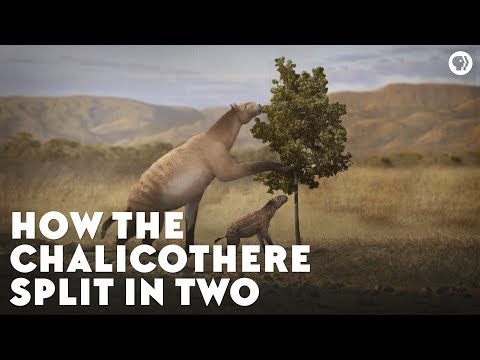
This creature is an extinct relative of horses and rhinos, known as a chalicothere.
And, this creature?
It's also a chalicothere.
Even though they look pretty different, both of these animals lived at the same time, and
in the same places, and they did the same things.
They're both closely related to each other, and to horses and rhinos.
And they both developed highly specialized adaptations that helped them exploit their
main source of food: the leaves at the tops of trees.
The first animal is known as Chalicotherium , and it wound up having enormous arms and
walking around on its knuckles, kind of like a gorilla.
The other is called Tylocephalonyx, and it turned out to look a little more horse-like,
but with a longer neck, and this weird, bony dome on its skull.
So, what happened?
How did two of the same kind of animal, living in the same place, end up looking so different?
The answer is parallel evolution.
You can't really talk about the history of life without talking about natural selection
-- the process by which living things can become more likely to survive, and to have
offspring that will also survive, if they become better adapted to their environments.
And chalicotheres are an especially great example of how this process actually works.
Because, in evolutionary terms, "better" can mean a lot of different things.
Success can take many forms, even for organisms that live in the same environment and face
the same challenges.
Before they diverged into different types, chalicotheres first showed up in Asia around
55 million years ago, during the Eocene Epoch of the Paleogene Period.
They soon made it to North America, Europe, and eventually to Africa.
During the Eocene, rainforests were widespread, and they became home to a new group of herbivores:
hooved animals called perissodactyls, which today include horses, rhinos, and tapirs.
"Perissodactyl" means "odd-toed," and like other members of this group, early
chalicotheres had hooves -- although their hooves were split in two, which was kind of
strange.
But as the Eocene ended, chalicotheres' hooves had been replaced with something new:
claws.
Now, claws on plant-eaters are pretty rare – so rare, in fact, that the paleontologists
who first found the feet of chalicotheres thought they must have come from anteaters,
or maybe giant pangolins.
But we know now that chalicotheres were herbivores, because their teeth bear the distinct scratches
and pits that come from eating leaves, bark and twigs.
So instead of using their claws for digging, these animals probably used them to get at
the tastier leaves that were higher up in the trees, a type of eating preference called
high browsing.
The claws may also have helped chalicotheres stand on their hind legs and brace themselves
against tree trunks, making it easier to browse.
And they even had specialized neck vertebrae that let them look up more easily than like
a horse or a rhino.
So, by about 40 million years ago, chalicotheres had arrived at a single, pretty successful
body plan, optimized for high browsing.
But then, things started to get weird.
Soon after the ancestral chalicotheres developed claws, they began to follow different evolutionary
paths.
They started to evolve in parallel.
One group of early chalicotheres got very good at pulling leaves down to eat.
So, over time, those animals with longer limbs were more successful, until -- about 30 million
years ago -- they all had big hulking arms, long claws on their front legs, and necks
much shorter than their ancestors'.
And because of this new body plan, these animals started walking with their front toes curled
inward to protect their claws.
They began walking on their knuckles!
These animals became known as their own subfamily of chalicotheres, called Chalicotheriinae.
But meanwhile, a separate group of ancestral chalicotheres started to develop its own adaptations
for high browsing.
Its early members were much better at nibbling leaves right off the trees, without having
to pull them down.
Over time, those that were taller and had longer necks were better at getting food,
until eventually, they looked more and more like long-necked horses.
Or maybe, short-necked giraffes.
And they still had claws, too.
But all their legs were about the same size, and these animals were bigger and heavier
than their long-armed cousins.
So, knuckle walking wasn't an option for them.
Instead, they acquired the ability to retract their claws.
They had specialized tendons that helped them pull their claws up while they walked, and the
tendons were further strengthened by a fusion of several bones in their toes.
And, in many members of this group, domes also appeared on their heads.
No one's exactly sure what purpose they served, but the prevailing theories are that
the animals used them for head-butting and as a display to potential mates. As you do.
And this group of long-necked, dome-headed chalicotheres came to be known by the ungainly
name of Shizerotheriinae.
But, just like the other subfamily, they were still chalicotheres!
So if these two groups of animals lived in the same area, why did they split at all?
Why didn't they keep evolving as one group, ending up either as long-armed knuckle-walkers
or long-necked horse-like dome head things?
Well, that's what makes parallel evolution so interesting.
It often occurs among closely-related animals, even ones that share the same range.
And in this case, it happened because both body plans were equally likely to help an
animal survive.
So, early on, among the original, ancestral chalicotheres, some variations appeared, which
happens all the time in groups of organisms.
Some chalicotheres had longer necks, and others had longer forearms.
But both differences helped ancestral chalicotheres survive, reproduce, and ensure that their
long-necked or long-armed traits were passed on to the next generation.
Slowly, over time, chalicotheres drifted apart, until their differences were so extreme that
they were different species - and then, different subfamilies.
But they both remained really good at doing one thing: eating the tops of trees.
Of course, as you know from the lack of them, their success didn't last forever.
Despite their specializations, chalicotheres aren't with us today.
The last of both families died out in North America 10 million years ago, and they lingered
in Asia and Africa until about one million years ago.
One possible clue to their demise is the rise of the artiodactyls -- herbivores with four-chambered
digestive systems, like deer, cattle, and hippos.
This digestive set-up is much more efficient than the single-chamber system that chalicotheres
had.
So chalicotheres would have had to eat a lot more to get the same nutrition that a giraffe,
for example, could get with less food.
And changes in climate wouldn't have helped: As Africa and large parts of Asia became drier,
grasslands started to spread, reducing the habitat of the tree-loving chalicotheres.
Today, horses are rhinos remain their closest living relatives.
So, you can take the story of the chalicotheres as proof of how versatile natural selection
can be -- how it can lead to many different evolutionary solutions to a problem, all of
which are equally successful.
But you can also read this story as a lesson in its limitations.
I mean, if anything, chalicotheres turned out to be too specialized.
Each group became too good at high browsing -- to the point that, when the climate changed
and competition pressure was on them, they couldn't survive.
There are some situations that evolution just can't get you out of.
Thanks to CuriosityStream for supporting PBS Digital Studios.
With CuriosityStream you can stream documentary films, and programs about science, nature,
and history, including exclusive originals!
For example, you could check out Planet Dinosaur, a three-part BBC series about the latest discoveries
from the days of the non-avian dinos.
CuriosityStream offers unlimited streaming, and for Eons viewers
the first two months are free if you sign up at curiositystream.com/eons
and use the promo code EONS.
What do you want to know about the story of life on Earth?
You can let us know in the comments.
And don't forget to go to youtube.com/eons and subscribe!
And then go talk to all your friends
and tell them to do it too
[laughs]



No comments:
Post a Comment