Tuesday, October 31, 2017

USA news on Youtube Oct 31 2017

Halloween is just around the corner, so let's talk about something that scares us and makes

us feel a little bit uncomfortable -- or at least makes me feel uncomfortable -- death.

Hey everyone! I'm Dana and you're watching Wanted Adventure Living Abroad.

In two days it will be Halloween, a holiday during which millions of people in the U.S.

and more and more people in other parts of the world dress up in scary costumes.

Some people, as I explained in last year's Halloween video, dress up in funny or sexy

costumes too, but the holiday itself is in general still about the celebration of things that

haunt and terrify us. One of those things being death.

Death is something that we often try to avoid talking about the whole rest of the year,

and then kind of let ourselves go crazy with on certain days, for example Halloween in the U.S.

So in honor of Halloween, I thought that I would make a video talking exactly about that

very uncomfortable and terrifying topic.

Because while death is something that we all have to face, it is handled differently in

some ways in Germany and the U.S.

For one, because death makes us feel uncomfortable, in both cultures we have a lot of euphemisms

for death.

In fact, I could probably spend a whole video just talking about sayings related to death,

but I'll just mention a couple of them here.

In English some idioms for "to die" include pass away, which is a polite ways of saying it,

as well as some more crude sayings like to bite the dust and to kick the bucket.

In German there's actually a similar saying to bite the dust except instead of dust, in

German it's grass -- ins Graß beißen.

And a polite way of saying it that's kind of like to pass away in German is

von uns gegangen, which literally means "went from us."

Another more crude way of putting it in German is abkratzen, which basically means something

like in English "to croak."

And then in German there's also den Löffel abgeben, which literally means in English

"to give up the spoon."

And in English I also know of two idioms that describe a person actually being dead:

six feet under and pushing up daisies.

And speaking of pushing up daisies, as far as I could find, in the U.S. when you purchase

a cemetery plot you're basically paying for that plot for "forever."

Of course at some point in the future it could happen that that land starts being used for

something else, but the general idea is that you are buying the cemetery plot for "forever."

So for the foreseeable future "forever."

Whereas in Germany that's not the case.

In Germany the cemetery plots are actually rented.

Exactly how long the rental period is differs around the country, but it's often around

20 to 30 years.

And for some graves, after that time the family can renew the rental, but for some types of

graves they can't.

For some types of graves that's it; you just get the one rental period.

And one difference that I've noticed as far as the cemeteries go is that in the U.S.,

from my experience and from what I've seen on American TV shows and in movies, because,

you know, that's a great place to get the most accurate information, movie and TV shows...but

yeah, from what I've seen, it seems like in the U.S. people often visit the grave of a

loved one on a special day of the year, for example maybe an anniversary.

And then they often bring a bouquet of flowers to lay on the gravestone.

Whereas in Germany I've seen people visiting the grave or graves of their family members

every week.

They go there, put out new candles, they light the candles, they place new flowers on the

grave, and they clear away any leaves that have fallen on the grave.

They pick out the weeds that have grown there, really tidying up the grave or graves on a

pretty regular basis.

Something else that I have heard of and have seen happen here in Germany that I personally

haven't ever seen or heard of happening in the U.S. is that sometimes in Germany when

a person dies at home, instead of the deceased being picked up right away, the body is kept

in the home and friends and family can come over and say their final goodbyes, gather

around together and cry, tell stories.

And then later on in the evening, the deceased is picked up and taken to a funeral home in a hearse.

Like I said, I don't have any experience with that happening in the U.S., and I don't

really recall ever seeing it in any American movies or TV shows or hearing about that from

my friends or anything like that.

I think that usually the deceased is picked up right away, but I would love to hear about

your experience with it down in the comments. Thank you.

Also while in the U.S. cremation I would say is a pretty common thing, in Germany the option

of cremation is still a relatively new one, and up until rather recently even if someone

was cremated in Germany those ashes still had to be buried, whereas now from what I

could find Germany has started to allow the possibility of ashes, for example, being strewn

in a cemetery, rather than being buried.

Or brought out to sea, beyond the three mile limit. But that's it.

Unlike in the U.S. where many families keep the ashes at home in an urn, which is sometimes

put up and displayed in the living room.

And as far as funerals go, in both the U.S. and Germany black is the traditional color

worn for mourning.

And in Germany after the funeral it's a common tradition for the family of the deceased

to provide what is called Beerdigungskuchen, literally "funeral cake."

So my question for you is: What are your thoughts on this topic and how are things surrounding

death done differently in other places?

Please let me know in the comments.

Thanks so much for watching, I really hope that you enjoyed this video about a little

bit more of a creepy topic this time.

And also a really big thank you so much to our patrons on Patreon, who help make these

videos possible.

Thank you so much for your support.

If you would like to check out our Patreon page, you can find a link to that down in

the description box below.

Until next time, auf Wiedersehen!

Yeah, but I laugh when I am talking about topics that make me nervous.

I start to laugh.

And then people are like, this isn't funny.

And I'm like no, I don't think it's funny, I'm just nervous.

For more infomation >> HALLOWEEN SPECIAL: Death in Germany & USA - Duration: 7:52.

-------------------------------------------

Jake Paul vs Average American - How Do They Compare? - People Comparison - Duration: 7:53.

The rise of the YouTube star, a fairly recent phenomenon, is making some young folks very

wealthy without having their stardom officially sanctioned by mainstream plaudits.

One such star, PewDiePie, was riding the wave of fortune until last year his popularity

– in the media at least – took a hit.

As hate seems to be as popular as love on social media, it's not surprising he gained

even more followers after his YouTube faux pas.

It's reported that the 27-year old Swede, real name Felix Kjellberg, made around $15

million in 2016.

His videos might be a tad silly, but that seems to work for his 57,208,847 YouTube subscribers

who've watched his goofiness an astounding 16,091,506,768 times.

Not long ago one man claimed he was going to overtake PewDiePie, and that's who we're

going to look at today, in this episode of the Infographics Show, Jake Paul vs the Average

American.

Don't forget to subscribe and click the bell button so that you can be part of our

Notification Squad.

First of all, when Business Insider put together a list in May containing the world's 20

most popular YouTube stars, Jake Paul wasn't even on the list.

If he really is posing a threat towards PewDiePie's YouTube supremacy he has a long way to go.

The list put PewDiePie in first place with 54.2 million subscribers.

Since the article was published in May, the numbers have obviously changed.

Second on the list was Latin America's biggest YouTube hit, Germán Garmendia, with 31.2

million subs.

Third was Spaniard Rubén Doblas Gundersen, aka, ElRubiusOMG, with 23.5 million subs.

Fourth was the comedy duo known as Smosh with 22.6 million subs and 5th was Canadian youngster

Evan Fong, whose gaming channel has 20.2 million subs.

We don't need to tell you that all these people are multi-millionaires.

As for our boy Jake, where does he stand?

Well, if you check his YouTube analytics, he's doing alright for sure.

As of this writing, his channel has 10,453,927 subs and in the last 30 days he's gotten

almost a million more.

The "England is my country" infamy no doubt bolstered his current success.

His videos have been watched a staggering 2,221,277,736 times and in the last 30 days

430,746,000 times.

With those figures, he certainly has some room to boast about rising up the ranks to

meet his Swedish nemesis.

But how does he compare to the average American?

A quick look at his basic information shows the 20-year old Jake Joseph Paul was born

in Cleveland and grew up in Ohio.

His dad was a realtor and his mom was a nurse.

This makes Jake what we call a Millennial – somewhere between the age of 18-34 (some

say 29).

The median age in the USA is currently 37.8 years old according to the last available

statistics.

So he's much younger than most American folks.

He is, however, in the same age bracket – 18-24 – as 30.8 million Americans, or 9.5 percent

of the population.

As for the Millennial YouTube generation aged 18-34, they make up 23.4 percent of the American

population, or 75.5 million people.

We can perhaps understand his popularity by collating this number with the largest group

of YouTube consumers by age, which is, again, 18-34 year olds.

We can't find a statistic for how many people in the USA were born on January 17, but our

ambitious Capricorn called Jake was born on the same date as Mohamed Ali, Benjamin Franklin,

Al Capone, Kid Rock, Andy Kaufman and Jim Carey.

If you've watched Jake's antics, the last three might make some sense, although he may

have some growing up to do.

Jake has one brother – also a YouTube star – so his two child family is less than the

American average of 2.6 children per family.

As for his ethnicity it's difficult to find any information, but when we looked at the

etymology of his family name of "Paul", and his mother's maiden name of "Stepnick",

we can assume he has European ancestry, possibly a mix of German, Austrian, or even Scottish

or French.

This would put his ethnicity as a white American, the same as 72.4 percent of other white Americans.

If he does have German ancestry, that would also tie him to 17.1 percent of Americans

with German ancestry.

We might also surmise that he is Christian, or at least comes from a Christian background.

About 97 percent of all Ohio residents who affiliate with a religion are from one of

various Christian churches.

70.6 percent of the American population identify as being Christian, while agnostics and atheists

now outnumber the smaller religions in the U.S.

As for Jake's face, he looks like a European with his blond hair and brown eyes.

According to the Huffington Post, natural blondes in the USA only make up 5 percent

of the population.

Brown eyed folks make up around 41 percent of the population, although sources seem to

differ on the exact percentage concerning eye color.

One website that publishes the measurements of celebrities tells us that Jake Paul is

"athletic", 6 feet 2 inches tall (188cm) and 192 pounds (87 kilos).

This makes him much taller than the average Joe in the U.S. who is said to be around 5

foot 9 inches (178.8 cm).

His weight of 192 lbs (87 kilos) for such a height definitely doesn't make him a sufferer

of the great American obesity epidemic.

The average American man presently weighs 195.5 (88.6 kilos), according to the Center

for Disease Control.

According to some reports Jake didn't technically finish high school, and he left the place

disgruntled with education, as well as leaving behind a few people that have come out and

said he was a bully.

He's quoted as saying he wouldn't have returned to "that Place" unless it was

in a Rolls Royce, but we cannot confirm this as the source looks quite dubious.

But let's say Jake didn't finish high school.

According to the Department of Education, that makes him much less than average, as

over the last few years the rate in the USA has been around 80-83 percent of kids getting

their high school diploma.

But Jake may have left for a good reason, just as Bill Gates bid adieu to Harvard before

getting his hands on a bit of signed paper.

Jake left home and moved to Los Angeles.

This makes him a little average as his Yellow Brick Road-type dream has become a bit of

a cliché, as well as LA being the second most populated city in the USA behind New

York City.

Its population is 3,976,322.

He went there for fame and fortune, and according to some sources lives in an apartment with

his Team 10 work buddies for a rental cost of 17,000 dollars a month in the small neighborhood

of Beverly Grove.

We looked at rentals in this area and found some nice places for 4,000 dollars a month

and one very cool looking pad for 7, 500 a month, so no doubt Jake is paying more than

the average for this area.

The latest data shows the average rental cost in LA is 2014 dollars a month, but the average

in the entire country is closer to 1,000 dollars.

He's also causing lots of trouble for his neighbors, which could land him a fine for

causing a public disturbance.

He pretended to have been arrested but that was just a prank, and so Jake can't yet

join the ranks of 1 in 3 Americans that have been properly arrested by the police.

Jake might not care, having made obscene of amounts of money for his bling and expensive

stunts by the time he was barely old enough to vote.

It's thought his present net worth is around 4 million dollars.

That's doesn't seem like much compared with some of the figures we often discuss

in our shows, but CNBC reports that he was a self-made millionaire by the time he was

19.

In another report, CNBC said that America now had a record number of millionaires at

10.8 million, which is around 3 percent of the 323-plus million population.

Nonetheless, research shows us on average it takes a self-made millionaire 32 years

to acquire their fortune, while Jake did it at hyper-speed.

Even more impressive is the fact the average net worth for someone aged 18-35 in the USA

according to the Census Bureau is 6,676 dollars for a man.

Even at the highest range for a man at 65-69 years old, the average net worth is 194,229

dollars.

Most folks without a high school diploma in the USA will make an average wage of about

20,241 dollars a year.

When interviewed by CNBC on TV, Jake said once he got savvy to better monetization practices,

his salary went from 6 to 7 figures.

We don't have much time to talk about Jake's likes and dislikes, but we do know he likes

his pet dog.

According to insurance research, Jake being a dog owner puts him with another 60.2 million

American households.

So, what do you think about Jake Paul?

Do you aspire to do something similar?

Let us know in the comments!

Also, be sure to check out our other video called Bill Gates vs the Average American?!

Thanks for watching, and, as always, don't forget to like, share, and subscribe.

See you next time!

For more infomation >> Jake Paul vs Average American - How Do They Compare? - People Comparison - Duration: 7:53.

-------------------------------------------

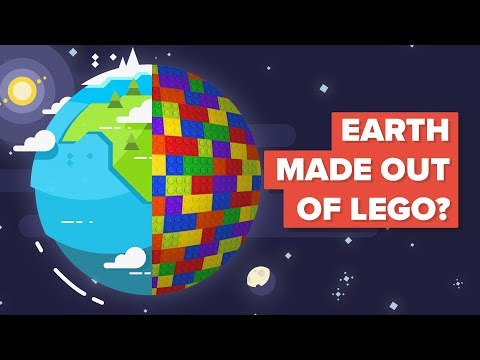
What if Earth was Made Out of Lego? - Duration: 4:57.

What if we made a lifesize model of the earth out of Legos?

What would it look like, how many bricks would it take, and is it even possible?

To give you a sense of how big a project this is, we would need over 100 quintillion Lego

bricks.

Stacked end to end, these Lego bricks would make a tower 400 million lightyears tall,

which, if it were on earth, would extend across the entire Laniakea supercluster of galaxies,

where our Milky Way lives.

So this is a lot of Legos- and we're excited to hear how they stack up, in this episode

of The Infographic Show, What if Earth was Made out of Legos.

Don't forget to subscribe and click the bell button so that you can be part of our

Notification Squad.

Before making the earth out of Legos, let's see what happens if we just try to build this

cosmic tower.

If we began by stacking Legos on the surface of the earth, we wouldn't get very far.

Every material, whether it's steel (skyscrapers), rocks (mountain), or plastic (Legos), has

a breaking point- there is simply a maximum amount of weight it can support before breaking.

Once we've stacked 320,000 bricks, we won't be able to go any higher.

The weight of the tower would crush the base flat, and adding more bricks to the top would

only serve to crush more bricks on the bottom.

This is already beginning to spell bad news for our project - the earth's gravity is

simply too strong and Legos are simply too weak.

But you may remember that everything is weightless in space - the Lego tower on earth has to

be different from a Lego ball in space, right?

Unfortunately, we'll still run into the same problem.

If we started building a giant Lego ball in the vacuum of space, we wouldn't have to

worry about the strength of the plastic to begin with.

But as we add bricks and as our model grows, so too does its mass, and therefore, the strength

of its gravity.

When our Lego earth is 625 km across, barely a tenth of the size of the earth, the central

bricks will begin to be crushed from the immense pressure of the bricks above them.

So Planet-Lego starts to collapse on itself when it's barely larger than an asteroid.

This isn't due to any structural shortcoming of Legos, the same size-dependent crushing

controls the shape of ordinary heavenly bodies as well.

In fact, there is a cutoff size, known to experts as the potato radius, below which

a proto-planet can have shapes various and sundry, from a round ball to a spiky potato.

But as soon as a proto-planet gets any larger, it gives way to its own crushing self-gravity

and becomes a ball.

[Sponsor message starts] I'm not going to run through the theory,

but if you want to see how this really works, I strongly recommend you check out our partner,

Brilliant.org.

They are a problem solving website that teaches you how to think like a scientist by guiding

you through problems.

(They take concepts like these, break them up into bite sized chunks, present clear thinking

in each part, and then build back up to an interesting conclusion.)

They have an entire course on Gravitation where in addition to interplanetary orbits,

black holes, and dark matter, you can learn exactly how proto-planets crush themselves

into balls, starting from the very intuition we got from the Lego tower at the beginning

of this video.

If you visit brilliant.org/theinfographicsshow (or click the link in the description), you

can sign up for free and learn all kinds of math and science.

And as a bonus to The Infographics Show viewers, the first 200 people that go to that link

will get 20% off the annual Premium subscription.

[Sponsor message ends]

Okay, so that's two strikes against building a Lego earth.

We'll never get enough Lego bricks, and even if we could, the bricks would be crushed.

So what if instead of worrying about practicality, we just magically replace the real earth with

a Planet Lego?

What would happen?

This Lego-earth weighs a tenth of the actual earth, about as much as Mars, because Lego

bricks are a tenth the density of the iron-nickel fluid that makes up the bulk of our planet.

And as with our first attempt, it would immediately crush the bricks inside it.

Lego bricks are about half empty space, so our Lego earth will shrink over a thousand

kilometers as it squeezes out all those gaps.

In the process, the friction and warping of the plastic and the pressure all conspire

to heat the bricks to 15,000 degrees Celsius.

Lego bricks are made from a plastic known as acrylo-nitrile butadiene styrene, also

known as ABS, which has many common uses on earth, such as manufacturing and 3D printing,

because it is very pliable when heated.

Though at 15,000 degrees, the ABS would likely combust and burst into flames, but in our

model there is no oxygen - only Legos.

Instead, the ABS breaks down into its atomic components, carbon, hydrogen, and nitrogen,

giving Lego-earth a molten white-hot core.

The outer layers don't break down so horrendously, instead forming a sort of liquid Lego-plastic

mantle, with a cold crust of unharmed bricks at the top.

You might worry that replacing the earth with a Lego earth would have a catastrophic effect

on our orbit, but fear not.

The new Planet Lego can orbit the sun just like any other body in the solar system.

In the coming years, the surface layer of Legos will lose their color, being baked in

ultraviolet rays from the sun - the same light that gives us sunburns.

As the eons stretch on, the plastic on the scorched surface of the planet grows brittle,

becoming increasingly marked by impact craters which will last for eternity, not too different

from the moon.

As the core cools over millions of years, the material will begin to separate out.

Hydrogen will form H2 gas and will leak to the surface, briefly supplying the planet

with a thin atmosphere which will be washed away in the solar wind, as the core turns

solid and freezes, perhaps to diamond.

So if any aliens came looking for us far far in the future, they would, at the very least,

be incredibly confused by what they find.

What do you think of Planet Lego?

Best idea ever?

Worst idea ever?

Let us know in the comments!

Also, be sure to check out our other video called Earth Millions of Years Ago!

Thanks for watching, and, as always, don't forget to like, share, and subscribe.

See you next time!

For more infomation >> What if Earth was Made Out of Lego? - Duration: 4:57.

-------------------------------------------

What if Google Was A Country? - Duration: 8:02.

As consumers experience the modern day phenomenon of hyper-connectivity, tech companies are

being scrutinized for the incredible monopolies they are building.

In August this year, Google was accused by an academic writing for a Google-sponsored

Think Tank of having such a monopoly, and he was subsequently fired after he aired this

criticism.

While we enjoy, and perhaps sometimes dislike, having thousands of virtual friends while

we share our opinion and habits with servers in data centers the size of small villages,

the tech giants behind our new addiction are becoming rich to the nth degree.

As you know from some of our other shows, tech companies stand tall as some of the wealthiest

companies in the world.

Critics tell us we need to harness their power lest they gain too much control over the populace.

Today we'll examine tech power, in this episode of The Infographics Show, If Google

was a country.

Don't forget to subscribe and click the bell button so that you can be part of our

Notification Squad.

Let's first have a look at how Google Incorporated got off the ground.

If you visit Google's company site and hit their history tab, the first thing you'll

see are two young men that barely look past their teen years sitting in a messy office

full of computer parts.

Those two men are Larry Page and Sergey Brin.

Brin was a student at Stanford University and Page was on his way to becoming a grad

student there.

Working from their dorm rooms, they came up with an idea of how to categorize pages on

the World Wide Web.

It was their first search engine and it was called Backrub.

Thankfully they soon had some sense and changed the name to Google.

The name was a play on the word "Goo-gol", which is the number one followed by 100 zeroes.

What it really signified is that Google was intended to deliver reams of information.

Google's one and only intention before it branched out into such things as self-driving

cars and futuristic glasses was "to organize the world's information and make it universally

accessible and useful."

Their idea was a success and soon Silicon Valley's venture capitalists were throwing

money at the pair.

The company grew at a rapid pace and soon had to move to a much bigger headquarters

which they named the "Googleplex", located in Mountain View, California.

Today Google is much more than just a search engine.

It offers a multitude of web-based products, advertising services, communication and publishing

tools, tools for developers; it guides us around the world with its mapping products,

as well as giving us operating systems – notably Android – web apps, email, a ton of hardware,

self-driving tech, as well as owning the website you are currently watching.

This is why Google, or its parent company, Alphabet, has a valuation of 676 billion dollars.

Only Apple can beat that, with a valuation of over 800 billion.

Let's now try and put that into perspective.

If Google was a country and its net worth was compared to a country's nominal GDP,

Google would be the 19th largest economy in the world after The Netherlands, and just

beating Switzerland.

Basically, if you wanted to buy Google, you'd need the entire Swiss GDP and a bit more.

If we look at revenue alone, Google earned about 90.2 billion dollars last year.

That would still make Google a pretty big country, putting it in 65th place in the world

in terms of GDP.

That would be just below Ukraine and just above Slovakia.

In 2016, Fortune magazine listed Alphabet as the world's 8th most profitable company.

In total it netted 16.3 billion dollars.

This puts Google the country about the same as the world's 115th richest country in

terms of GDP, which is Bosnia and Herzegovina.

But that country has 3.5 million people to share its GDP with; Google only has 72,053

employees it must support.

This would make Google the 14th smallest country in the world, with a population slightly less

than the country Dominica.

The GDP of Dominica is 525.4 million dollars.

What we are saying is that if Google was a country, it should be almost utopian with

that amount of cash.

So, where does all the money go?

Does Google embrace an equitable spread of wealth?

It would only be right to call the Chief Executive of Google a kind of king, as companies are

generally not run like democracies.

The staff don't control matters.

The CEO does, but he or she can't do very much without the board's consent.

We could call the board the advisers to the king.

So, our King is called Sundar Pichai, an Indian American man that married into the Google

family.

As always, these days, the king is controlled by many people and some invisible hands that

orchestrate matters behind the scenes.

The other big players behind the scenes in the Google country are Eric Schmidt, Executive

Chairman of the Board of Directors; Sergey Brin as President, and Larry Page as CEO of

Alphabet.

We could say that Pichai is a smaller player than the others, but as we said there are

always powerful behind-the-scenes players in any government or monarchy.

But do these guys share the wealth with the average Joe in the Google country?

First of all, we should know that a lot of money goes into future developments and acquisitions.

In fact, it's said that Google has been buying about one company a week since 2010.

One of Google's most famous and costly acquisitions was YouTube, which cost Google a whopping

1.65 billion dollars back in 2006.

It's thought that YouTube is now worth more than 70 billion dollars, so Google the country

got a lot richer.

The leaders of country Google have also made some bad moves, which includes buying Motorola

for $12 billion, and then selling it for $3 billion two years later.

So, the biggest wages at Google go to the big players, but not the two founders, who

each receive just one dollar a year!

But don't feel too bad for them just yet.

These guys discovered the country and then left it to other people to run it.

They don't get salaries, but they are very wealthy because they get money from stocks.

According to Forbes, Page is worth 45.1 billion dollars, making him insanely more wealthy

than Google the country's average worker.

Brin is worth almost the same with 43.4 billion dollars, and what's a couple of billion

to these two.

They even have private planes that have runways in NASA, where no other planes are allowed

to land.

The king of Google, Sundai Pichar, is said to have earned a total compensation of 200

million dollars in 2017.

Eric Schmidt is said to earn more than 120 million a year and former business officer

Omid Kordestani was pulling in over 130 million a year before he went over to Twitter.

So yes, Google is an oligarchy but its top staff do ok too.

Pay scale sites say that directors of engineering receive 571,000 dollars a year, much more

than the average American with an advanced degree, which is around 70,000 dollars a year.

A director of Product Management at Google will get about 409,000 dollars a year, and

a Senior Research Scientist will receive more than 300,000 dollars a year.

But these are the top positions.

What about your average programmer?

According to Glassdoor, they get in the region of 120,000 dollars a year, but that can go

up quickly as you rise in the engineering ranks.

Accounts managers get around 80,000 dollars, higher than the US national average of 60,000

for that job – according to Glassdoor.

The same website says Google's cleaners get around 50,000 dollars a year, which seems

very high.

In all, Google UK said the average wage throughout the whole company was around 206,000 dollars

a year.

This means wages in Google the country are much better than any country's average wage.

Maybe that's what you'd expect from a small country with massive wealth.

Workers also receive full benefits at Google, dogs run around on the office floor, snacks

are everywhere, there are gyms, massage, and amazing death benefits for those left behind

if you die on the job.

Sounds like heaven, but when Business Insider asked what it was like working in country

Google, some of the replies were less than positive.

"All those perks and benefits are an illusion.

They keep you at work and they help you to be more productive.

I've never met anybody at Google who actually [took] time off on weekends or went on vacations,"

said one person.

Another complaint was lack of diversity, which follows the tech initiative to seemingly go

after young white men.

"They hire the same person over and over again," said one person.

Google was recently investigated by the US labor office for gender discrimination, but

then later was famously accused by an employee of forcing the diversity issue too much.

If Google really was a country, 75 percent of the population would be male; there'd

only be about 2 percent of African-Americans, 4 percent Hispanic, and about a third of the

population – based on US staff – would be Asian.

That would mean that our country would be made up of mostly young white men, many of

whom would be nerds, according to Business Insider.

In conclusion, if Google was a country, its citizens would no doubt live in comfort and

be well-off.

There would be no poverty, but people would do little else but work.

Even though they would be taken care of, in essence they'd be slaves for a few men at

the top of the Google food chain.

Google the country might be like living in ancient Sparta, if you just switch fighting

for programming.

So, would you want to live in Google the country?

Let us know in the comments!

Also, be sure to check out our other video called McDonalds vs Burger King?!

Thanks for watching, and, as always, don't forget to like, share, and subscribe.

See you next time!

For more infomation >> What if Google Was A Country? - Duration: 8:02.

-------------------------------------------

Trump Loves "The King Of China" - Duration: 3:25.

PRESIDENT TRUMP WAS TALKING TO LOU DOBBS, IT WAS A REALLY

GROSS INTERVIEW BASICALLY ASKING SOME BACK AND FORTH.

BUT THAT IS NOT THE BEST PART, IT IS WHEN DONALD TRUMP STARTED

TALKING ABOUT THE CHINESE PRESIDENT.

BUCKLE UP THERE'S NO WAY HE'S NOT GOING TO SAY SOMETHING

STUPID.

HE IS A POWERFUL MAN, I HAPPEN TO THINK HE IS A VERY GOOD

PERSON, WITHOUT BEING SAID HE REPRESENTS CHINA, I

REPRESENT THE USA SO THERE'S GOING TO ALWAYS BE CONFLICT.

WE HAVE A VERY GOOD RELATIONSHIP, PEOPLE SAY WE

HAVE THE VERY BEST RELATIONSHIP OF ANY PRESIDENT.

SOME PEOPLE MIGHT CALL HIM THE KING OF CHINA, BUT HE IS

CALLED PRESIDENT.

NO ONE CALLS HIM THE KING OF CHINA.

THAT IS NOT A THING THAT EXISTS.

SOME PEOPLE MIC ON THE KING OF CHINA BUT HE IS ACTUALLY A

PRESIDENT.

YES, THE REST OF US ALREADY KNEW THAT.

CAN YOU TELL WHAT IS ACTUALLY HAPPENING HERE.

HE FELT THE CHINESE LEADER WAS A KING.

SHE IS JUST SO STUPID.

THE FUNNY POINT ABOUT IT IS HOW PROUD HE IS THAT HE FIGURED OUT

BEFORE HE WENT ON TELEVISION WHAT NINE MONTHS INTO HIS

PRESIDENCY THAT THE LEADER OF CHINA IS NOT A KING BUT A

PRESIDENT.

THE PRESIDENT OF THE UNITED STATES OF AMERICA SHOULD ALSO

KNOW THAT.

WHO SAYS THINGS LIKE PEOPLE SAY WE HAVE THE BEST RELATIONSHIP OF

ANY PRESIDENT?

WHAT DOES THAT MEAN?

FIRST OF ALL EVERYTHING HAS TO BE THE BEST.

REMEMBER IN PUERTO RICO WE HAVE THESE BIG BEAUTIFUL SOFT TOWELS.

OH MY GOD HE IS AN ABSOLUTE IMBECILE.

YOU KNOW HE IS A VERY GOOD PERSON.

HE SAID HE LOOKED INTO PUTIN'S SOUL AND THOUGHT HE WAS A

GOOD PERSON.

DON'T FORGET BUSH WAS PRETTY BAD.

AMONG REPUBLICANS HE IS STILL POLLING AT AN ASTRONOMICAL RATE.

For more infomation >> Trump Loves "The King Of China" - Duration: 3:25.

-------------------------------------------

BanglaVision Live News 31 Octobor 2017 Bangladesh latest news Today Bangla Breaking News all Bangla - Duration: 5:11.

for latest news update, please subscribe this channel

for latest news update, please subscribe this channel

for latest news update, please subscribe this channel

for latest news update, please subscribe this channel

for latest news update, please subscribe this channel

for latest news update, please subscribe this channel

for latest news update, please subscribe this channel

for latest news update, please subscribe this channel

for latest news update, please subscribe this channel

for latest news update, please subscribe this channel

for latest news update, please subscribe this channel

for latest news update, please subscribe this channel

for latest news update, please subscribe this channel

for latest news update, please subscribe this channel

for latest news update, please subscribe this channel

for latest news update, please subscribe this channel

for latest news update, please subscribe this channel

For more infomation >> BanglaVision Live News 31 Octobor 2017 Bangladesh latest news Today Bangla Breaking News all Bangla - Duration: 5:11.

-------------------------------------------

Breaking News LIVE . Press Briefing with Press Secretary Sarah Sanders Today 10/27/17 - Duration: 12:42.

For more infomation >> Breaking News LIVE . Press Briefing with Press Secretary Sarah Sanders Today 10/27/17 - Duration: 12:42.

-------------------------------------------

Restaurant Tipping in America Is...Bad?! - Duration: 11:35.

A tip is supposed to be a little extra bit of money, often given to reward good service,

but nowadays in some industries in the U.S., such as restaurants in particular, tipping

has stopped being a little something extra and instead it has become the customer actually

paying most if not all of the employee's earnings.

So is this a good thing or a bad thing?

Hey everyone, Dana here!

And I think tipping is good. And bad. Hmmm, okay wait, let me start over.

When I lived in the U.S. I did work as a server for a little while.

And let me just start by saying that I'm very sorry to anyone out there who had to

have me as their server, I was not cut out for that job and it wasn't one that I enjoyed at all.

But I did like the idea -- in fact I loved the idea that what I earned each day or evening

was based on my performance, and perhaps a little bit of luck as to who I got as customers.

I would go into each shift feeling like the sky was the limit for how much money I could make.

If I could just smile and really hustle and get to as many tables as possible without

spilling or dropping anything, who knows how much I could earn.

Maybe there would be someone really generous who would come in that evening and they would

leave me a huge tip that I was probably not so deserving of because I had probably forgotten

their drink or messed up their salad -- like I said, not a good server -- but sometimes

people were just super generous.

Sometimes customers just out of their kind hearts left me a very nice tip.

But sometimes they didn't.

I was left just thirteen cents one time, and, oh boy, was that a sad moment.

I had worked and worked and worked, so hard.

I was really trying my best.

And then I got just thirteen cents because the customer decided that I didn't deserve

to earn anything more than that.

The customer made that decision, that I didn't deserve to earn my wage for the work that

I had done.

Which when you think about it, is actually a pretty strange thing.

That doesn't happen at the movie theater.

The customers at movie theaters don't get to decide how much the person who sold them

the ticket should make that evening based on how much they smiled or how many mistakes

they did or didn't make.

Or what kind of a mood the customer is in that day.

No, that is between the employee and the employer to work out.

Not the customer.

But well, I mean, whatever, this is just how it's done at restaurants everywhere around

the world, right?

Wrong.

And I had no idea before leaving the U.S. for the first time, but no.

It is not the case everywhere in the world that the customers at restaurants are expected

to pay most or even any of the server's wage at all.

Here in Germany it is customary for a little tip to be left, usually I would say around

ten percent, but here this is a tip in the actual sense of the word, a little something

extra on top of what the server is earning.

But, for example, in Sweden from my experience, that's not the case.

We went to Sweden a few years ago and tried to leave a tip at the restaurant, but they

expressly said no, they would not take the tip.

They said that they had just been doing their job.

They wouldn't take it.

Even though out server had actually gone, as far as I'm concerned, above and beyond

her job that day.

The restaurant that we had gone to had just recently gotten a new menu and hadn't yet

had the chance to translate it into English, so it was only in Swedish.

So our server stood there and read through the whole menu to us, translating it into

English for us.

And still she would not accept a tip.

She said no, it's just, that's part of my job.

I've also heard that there's no tipping in restaurants in Japan too.

I don't know first hand, but that's what I've heard.

Okay, fine, but still this is how it's always been done in the U.S., so just leave it be.

Nope! Wrong again.

And first of all here, even if something had always been done a certain way somewhere,

why in the world would that be a good reason to keep doing it?

Just because something has "always been done a certain way," if we realize that now it's

not actually a good way of doing things, or maybe it was a good way of doing things at

one point, but now it's not anymore, then it should be changed, regardless of how long

it's been done that way. Right?

But anyway, no, it hasn't always been done like this in the U.S.

According to several articles that I read, which I will link to down below, America actually

got their tipping practices from Europe in the latter half of the 1800s.

And actually, at first, when tipping was first introduced from Europe into the USA,

a lot of people in the U.S. did not like it.

Being able to buy better service was actually considered anti-democratic at first in the U.S.

But, obviously, over time that changed.

Whereas in Europe some of the countries from whom the U.S. had actually first gotten the

idea of tipping, had, by the middle of the 1950s started scaling back their tipping,

either with mandatory service charges on the bill or mandatory wage minimums for the employees.

Which brings us to where we are today.

So is tipping like this in the USA bad?

Well, as someone who has worked as a server in the U.S., and as someone who has experienced

basically mandatory tipping in the USA, a little tipping in Germany, and from my experience

no tipping in Sweden, I have to say that I personally prefer the whole no tipping thing.

As a server in the U.S., yes, it was kind of exciting to think that the harder I worked

the more money I could make.

But for one, that made it all the more devastating when I didn't get a good tip, or any tip

at all, especially if I had done everything "right" and to the best of my abilities.

Just because the person eating forgot or didn't feel like tipping or whatever, just because

of that I didn't get paid for my work?

Come on, like I said, that doesn't happen in other jobs.

Sometimes at restaurants in the U.S. people don't like the food they ordered and then

because of that they don't tip the server.

Going back to the movie theater example, it's like, you can't go out and see a movie and then

if you don't like it, well sorry the person who sold you the ticket doesn't get paid that night.

But also, because of the tipping system in the U.S., when I was a server everything,

and I mean everything about my evening, became solely focused on making as much money as possible.

Because like I said I knew the sky was the limit.

So I focused so razor sharply on that bottom line that it really felt like any other measurement

of success, like enjoying the evening or making a fun connection with other people just disappeared.

Later when I worked as a hostess in a restaurant, where my earnings were the same no matter

what, I got paid per hour by the restaurant, I felt like I was finally able to enjoy my

job and enjoy the evening.

And for a while, yeah, I did think, like, well but the tipping system in the U.S. incentivizes

better service at restaurants, doesn't it.

But then I realized that actually makes no sense.

If I didn't give good customer service at the restaurant that I worked at as a server, yeah

I guess I wouldn't have gotten good tips, but I also probably would have been fired

for not doing my job because giving good customer service is a part of the job of being a server

in the U.S. Customer service is important in America, and I get good customer service

in the U.S. in places where there's no tipping at all, like at the grocery store.

Or when I worked as a hostess at the restaurant, I wasn't getting any tips, but I still gave

great customer service because that was a part of the job.

And actually I felt like I was able to give better customer service as a hostess because

I didn't have to worry about those tips.

And lastly, as a customer going out to eat, I personally would much rather just have a

set service fee that I need to pay, automatically added to my bill or, you know, just have the

server's payment included in the price of what I'm buying, just like at other places,

like at the movie theater or the bowling alley.

The cost of paying the employees is just added into the price that I have to pay when I go

do that activity.

This system seems to work just fine at other places. Why not at restaurants?

But that's just me.

So my question for you is: Do you think that tipping like this is good or bad?

Would you prefer to live in a world without tipping?

Please let me know in the comments below.

Thank you so much for watching.

I really hope that you enjoyed this video.

If you enjoy these videos, please don't forget to subscribe and hit that like button.

And also a really, really, really, really, really, really big thank you so much to our patrons

on Patreon who help make these videos possible.

Thank you so much for your support.

If you would like to check out our Patreon page, you can find a link to that down in

the description box below.

Until next time, auf Wiedersehen!

Which brings us to where we are today.

I'm hungry!

Then it should be changed, regardless of how long it's been done that way. Right?

Like we can learn from the past and change the way of doing something.

Yes?

That's the wonderful thing about humans. I think?

Until next time...I'm waving way too soon! Auf Wiedersehen! Okay, I'm done!

No comments:

Post a Comment