♪ To us a Son is born ♪
♪ Unto us a Child is given ♪
♪ God is with us, rejoice all you nations ♪
♪ And be humbled for God is with us ♪
♪ And governance shall be upon His shoulders ♪
♪ God is with us, rejoice all you nations ♪
♪ And be humbled for God is with us ♪
♪ And His name shall be called Wondrous Counselor ♪
♪ Mighty God, Everlasting Father, Prince of Peace ♪
♪ God is with us, rejoice all you nations ♪
♪ And be humbled for God is with us ♪
♪ Your Nativity, oh Christ, our God ♪
♪ Has shed upon the world the light of knowledge ♪
♪ For through it those who worship the stars ♪
♪ Have learned from the star ♪
♪ To worship you the Son of Righteousness ♪
♪ And to recognize in you the One from on high ♪
♪ Glory to You ♪
♪ Today the Virgin gives birth to the perfect essence ♪
♪ And the earth offers a cave to the inaccessible ♪
♪ The angels sing his glory to the shepherds ♪
♪ The wise men journey with the star ♪
♪ There is born for us an infant child, God Eternal ♪
♪ Christ our God bless this food and drink ♪
♪ For your servants for you are holy ♪
♪ Now and forever for ages of ages ♪
♪ Amen ♪
- In the name of the Father, Son, and Holy Spirit, amen.
(repeats in Ukrainian)
- We're doing all this stuff but why?
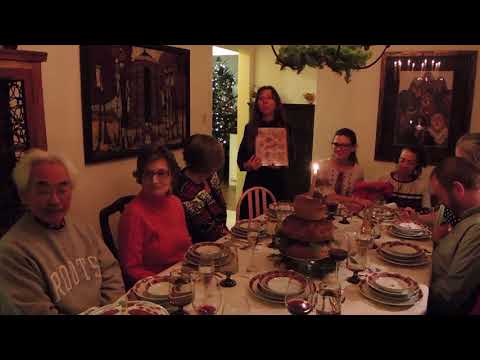
So, we start with the lighting of the candles
because Christ is,
the light of our life.
And we have a candle in the window
inviting any kind of wanderers,
travelers, anyone who doesn't have a place
to celebrate this Holy Supper this evening
to come in and join us.
So we have the empty place setting usually with a chair,
but not in our host home lately.
- If someone comes, then we will make room for them.
That's what that signifies.
They can sit on someone's lap.
- (laughing) Definitely, yes.
So, the empty place setting is for
the stranger, for the wanderer that may join us,
but it also is for all of the people who are not with us
who have died, who can't come,
who have celebrated in the past and even in the future.
So, we welcome everyone here.
In the corner of the room, along that line,
we have the sheaf of wheat,
and the sheaf of wheat is called the didukh,
which is from the word for
дід or grandfather.
Because that is a symbol of the generations
that we celebrate with, the generations in the past,
the people all over the world and all throughout time
that have celebrated this momentous event
of God becoming human, of being born as a person.
Also then, if you feel the crinkliness
underneath the tablecloth, that's hay.
It really is. - Not the Canadian eh.
Get real hay, not eh.
- And under your toes, it's not just
because we haven't had any time to vacuum.
- We haven't had, which might be the truth,
but still, no, it's hay underneath the table
to symbolize that humble birth.
The fact that God came to us as
a poor person with nothing,
and yet, saved all of humanity.
Our celebrations today reflect our icon
of the night Nativity that we had.
The incarnation, the whole mixture
of what we experience in our human life,
the joy together with the suffering,
pain together with happiness,
love together with so much,
so much trouble.
And yet, throughout all of that,
we can celebrate that God is with us.
And I love this icon because we have the mother of God
turned away from her child because of that pain.
We think, you know,
we've got the midwives in there, too.
The pain of childbirth isn't something
that we're forgetting about just
because we're celebrating the birth of God.
It's totally human, and it's totally divine.
As we hope to be, totally human, but totally divine.
Yay. (laughing)
- Totally.
- Totally divine.
So, yes, and again if ever you guys
want to look more closely at the icons of the Nativity,
we just have that mixture all the time.
There's Joseph being tempted to not believe
that his wife is actually faithful to him.
And the baby wrapped in swaddling clothes
but looking like a mummy in a coffin actually,
remembering that even though
we're celebrating this Nativity,
it's very real the way our lives are very real.
- Connected to death.
Huh? - Right, exactly.
- Connected to death. - Right.
- Yes.
- That's the motto of the mummy.
- And yet death then brings life.
- [Man] Exactly.
- So we have the kolach in the middle of the table
that thank you Myroslawa for baking.
And it is made in three tiers.
Braided with the three strands of dough
that then meet together into a circle
symbolizing the Trinity.
And the way our life then enters into eternity
with this celebration of the incarnation.
And also, the threes that we keep seeing
not only tonight but in our whole faith tradition
reminding us of the Trinity.
The Trinity as community and as we are.
So all day,
- [Woman] Did you mention the garlic?
- No, the garlic?
The garlic is there.
- [Man] Very Christian tradition.
- To make sure that even though we're inviting everyone,
we're not inviting the vampires tonight.
- [Man] No evil spirits, every of the evil spirits.
- There's people at the table,
and if anyone feels particularly sick,
they can feel free to take, bite off a chunk of the garlic.
Chew it along with their dinner.
- Okay, sorry Aleksandra,, just a little bit more then.
Oh dear, okay.
- [Man] Salt?
- [Man] Salt.
- The salt because we are all called to be
the salt of the earth as Christ
had demonstrated to us in His light.
Oh yes, and during the day, we were not eating any meals,
remembering the journey of the Holy Family to Bethlehem,
and the hardship that they had.
And yet, now when we're breaking that fast of the day,
we're having 12 dishes.
We're having a celebration, and yet,
the celebration is still part of the fast
because until we go to church,
we're not celebrating the actual birth of Christ.
So after which then we would have meat
and eggs and dairy stuff.
- But poor fish are not considered one of those.
- Fish aren't considered part of that.
Yeah, so we're having fish tonight.
- I think the fish activists would have an issue
in this situation.
- It's true, it's true.
But yes, and what's exciting for me tonight
on top of everything else that's exciting,
is that we have the 12 dishes that symbolize the 12 apostles
and how we too are followers of Christ as Christians.
But we have exactly 12 people at our table.
- Oh I never thought of that.
- [Man] Dun dun dun.
- So everyone just gets one dish.
(laughing)
You will eat that and only that.
(excited mumbling)
Yeah, exactly, exactly.
- Yeah poor Tom and Sean are kind of like,
you don't know what to grab first, right?
Because these are both your favorites.
- It's right in front of him.
- I'll be tolerant.
- Okay, no, it's okay, she's kidding.
- You think. (laughing)
- We begin with the first star in the sky of course,
recalling the star of Bethlehem.
- It's definitely out by now.
- It's definitely out.
- [Man] It's gone to sleep already.
- And normally, we would actually feed
any animals that we have first.
- All our animals are dead.
- All our animals are dead, it's true, oh dear.
In some parts of Ukraine,
I just learned this in the past year.
Susanne, this would be new if we,
but we're not doing it.
But the youngest people in the family,
in this case it would be you and Sean,
would be asked to go under the table,
and you'd make animal sounds.
- What, are you serious? (laughing)
- I'm not kidding.
I'm not kidding.
I am serious.
- [Man] So Sean, when you get that urge (speaks faintly).
- Did we plan on this business?
- But no, I'm not kidding, it's true.
But after when we get up before we go to church,
traditionally here in our household, we do do this.
People are invited to dive under the table.
- Not just the youngest.
- Not just the youngest, everyone is welcome
to find treasures in the hay underneath the table.
And this is for real.
I'm not kidding. (laughing)
Okay.
- And as we get older, the treasures get more, get nicer.
We have no grandchildren,
so there's like no (speaks faintly).
No one can be charmed with a nickel any more.
- Oh dear.
- I can't even make a phone call any more.
- Don't be disappointed, Anastasia.
Okay, so we start.
The first three dishes have their order,
and then we'll just bring things out.
We'll bring all the 12 out then after that.
We begin with the kutya because this is
a dish that symbolizes life.
It's made from boiled grain.
We have barley.
Often, it's wheat.
And this is a dish that's often also made
for funerals and for funeral celebrations
because of that symbolizing life itself.
And it's mixed with honey,
the beauty and the sweetness of life.
And the poppy seeds, the bitterness of life.
Also in our culture, we would think maybe the inebriation.
However, it's for the bitterness. (laughs)
All right and,
we begin with,
the oldest person in the household.
I just want to rub that in.
- The dramatic moment.
- I will yes, I won't explain it.
I'll just say if it sticks,
then it will be a good year, a good harvest.
And if it doesn't,
- [Man] Do it again.
- Well, too bad.
- She's telling me-- - Just a sec.
I also want to thank Anastasia for making this kutya.
Myroslawa did the kolach.
No, no, no, it's good.
- The pressure's on.
- Wait, wait, wait, before you start,
have I forgotten anything?
- [Multiple People] No.
- Okay.
(cheering and clapping)
That is a fabulous year, you guys.
- They'll get that in their wine glass later.
- No, no, no, it's there.
Okay, 2018, - It's a good year!
- Wonderful year for all of us.


No comments:
Post a Comment